Thermostatic Heads
1. What is a thermostatic valve?
This device allows for adjustment of a room's temperature by regulating the water flow in a radiator. Thermostatic valves can be controlled by a thermostat or manually.
Also known as thermostatic head, it is capable of detecting ambient conditions to assess the amount of hot water to use.
2. What is a manual valve?
Like the thermostatic head, it regulates temperature. However, the temperature must be adjusted manually by turning the knob.
3. What is a knob?
The knob is the visible part of the radiator valve, often white and sometimes designer.
4. What types of connections are possible?
Most thermostatic heads use a threaded connection, which can simply be unscrewed.
However, some manufacturers, like Danfoss, sometimes use a claw system. In this case, you must hold the knob and turn the ring to open the claws.
5. What is the difference between frost protection and position 0?
The frost protection function automatically allows 7°C to prevent the system from freezing in winter.
Position 0 completely shuts off the radiator valve. The radiator head then acts as a true blocking valve. Be aware that this means your radiator is at risk of freezing when temperatures drop.
6. What is temporal variation?
This indicates the potential for temperature variation, from 0 to 0.x °C.
For example, a temporal variation of 0 to 4 for a radiator valve that should heat to 19°C means it varies the temperature between 19.0°C and 19.4°C.
According to RT2012, the lower the temporal variation, the more the installation meets current standards.
7. What is the European pitch?
It is M30 x 1.5.
M30 is the size of the connection for the radiator valve, male, and 1.5 is the thread size of the radiator head for the connection.
You can also find the M28 size quite frequently in the installed base.
8. What is kvs?
It is a measurement of the quantity of water at 20°C in an element, over one second.
9. What is a high authority valve head?
A radiator valve head that causes a low kvs.
10. How long does it take for an accurate head to respond?
It responds in about 18 minutes. Just enough time to bake a pie!
11. How does a thermostatic head control temperature?
For comfort and energy consumption, it controls the temperature of a room by taking advantage of solar gains (up to 20%) and other ambient elements (guests, oven, etc.).
12. What savings can be achieved with radiator heads?
From an energy perspective, savings of between 15% and 35% are possible depending on manufacturers.
13. What is an inviolability ring?
This is an additional function that can be useful when renting real estate to prevent vandalism.
It is often found in public places (hospitals, schools, etc.).
14. What is a lockable head?
A lockable radiator valve can be unclicked to redefine the maximum temperature, thereby limiting energy consumption, for example.
15. What is an electronic thermostatic head?
This is the future at the touch of a click!
Valve Bodies
1. What is a valve body?
Between the thermostatic head and the radiator is an element generally made of brass, known as a valve body.
2. What is an adjustment tee?
This is a radiator valve body that installs horizontally.
3. What is an adjustment elbow?
This is also a valve body but installed vertically.
4. What is a thermostatic assembly?
A radiator head and a body form a thermostatic assembly.
5. What type of thermostatic body should I use for my installation?
There are 3 options, depending on your heating system:
- Angled: used when water enters through the wall.
- Inverted angled: when water enters from the floor.
- Straight: when water comes in parallel to the wall.
6. What is the average lifespan of a valve body?
A well-maintained body lasts about twenty years.
7. What degrades the quality of a thermostatic body?
Generally, limescale, corrosion, mud, etc. To avoid these inconveniences, remember to maintain your heating water and follow our restart tips.
8. What is a thermostatic insert?
This is the small rod that extends from the body of the valve and inserts into the radiator head. It triggers a spring that opens the valve according to the thermal needs of the room.
The thicker it is, the more durable it is. Furthermore, the spring must withstand a certain pressure.
Valve bodies with springs allowing 5kg of pressure and an insert of 0.4 mm thickness help prevent the whole assembly (head and valve) from seizing after the summer when restarting the radiators.
Install Like a Pro
1. What tools should I have in my pro toolbox?
First, have a toolbox or a backpack for tools. That’s essential.
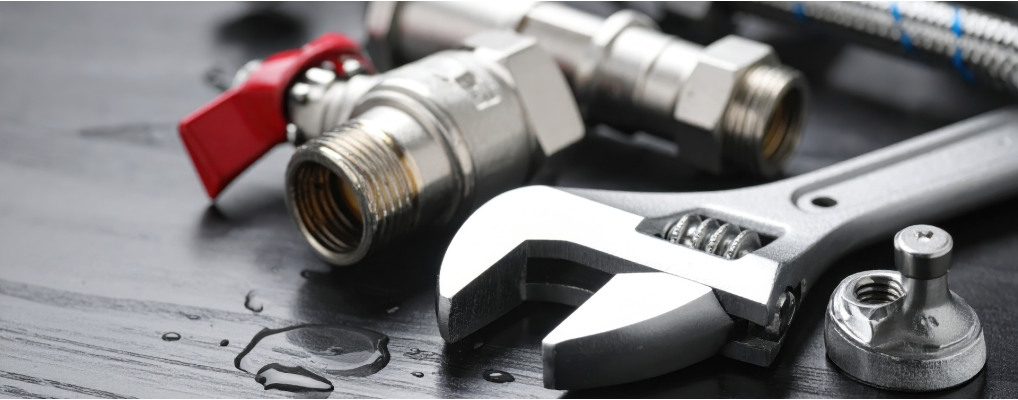
Next, a wrench to remove the packing nut and loosen the insert. Without pliers, you would need a 19mm and a 17mm wrench.
Remember to bring a container, some cloths, and a pair of gloves in case some (or a lot!) of water leaks out.
2. Is there an ultra-quick solution for removing and reinstalling an insert?
Yes! Nothing is more effective than the Demobloc. No leaks, no risk of burns, and easy to use.
In 5 minutes, you can remove an insert and replace it.
Such a product doesn’t require professional knowledge, but we only recommend it if you have multiple floors or several properties.
It’s a high-end product for any DIY enthusiast!
3. My thermostatic body is old and leaking a bit, what should I do?
You have two options:
- The thread seal: this product comes in tape form (like adhesive tape) and is used for sealing sanitary water circuits.
- The sealing resin: it usually comes in a small tube, like glue, and is to be applied directly to the connection needing sealing. It’s also available in paste form.


 Pièces détachées Saunier Duval sur Expertbynet.fr