About one-third of homes in France suffer from humidity. To address this, it is highly recommended to install a Controlled Mechanical Ventilation (MVHR) system. There are single-flow and double-flow MVHR systems.
Moreover, to avoid unsanitary conditions, equip your home with the essential elements for your health thanks to our previous article on home ventilation.
Humidity: The Home’s Plague
It makes your walls sweat and causes their beautiful wallpaper to peel. Humidity can cause paint to flake, walls to weep, and mold to develop. When your home is sick, so are you. How? First, humidity promotes the proliferation of dust mites in your bed, clothing, cushions, and even your bath mat! It's itchy, irritating, and unbearable.
Then, more serious problems may arise due to the polluted air and mold (generally noticeable as stains on the walls, for example). While your home deteriorates, your health worsens. Joint issues, respiratory problems, allergies…
Whether you are allergic to dust mites or not, this article is here to help you maintain comfort at home.
For your home to be healthy, the humidity level should be between 40% and 60%, at most. If it exceeds this threshold, consider it time to take action before damage occurs.
The MVHR is the safest and most economical way to renew the air we breathe in our homes.
Single-Flow MVHR
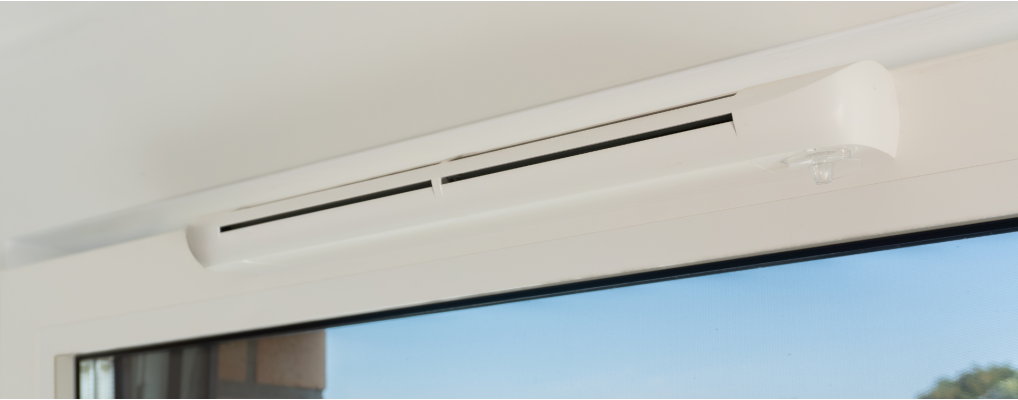
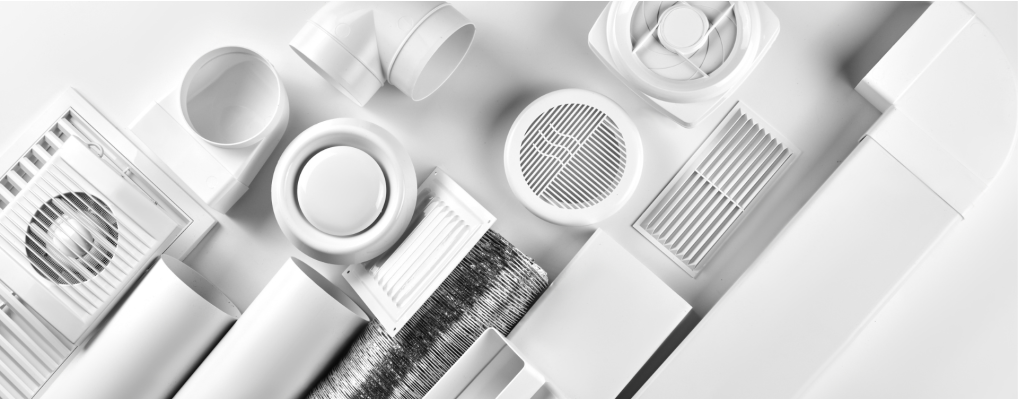
The living areas of your home feature air inlets that allow outside air to circulate through air entry grills. The air circulates within the home and exits through areas that generate humidity (kitchen, bathroom, and toilet). To extract sufficient air through air extraction vents, the single-flow MVHR absorbs humidity by passing it through ducts and then expels it outside.
There are two types of single-flow MVHR:
- The self-regulating single-flow MVHR: it expels a constant airflow from water-related rooms and the kitchen, without considering humidity or weather conditions. It is simple and effective, yet it's not the best solution for protecting your home.
- The hygro-regulating single-flow MVHR: much more suitable, a hygro-regulating MVHR unit can manage the humidity of the home to combat incoming moisture when it rains or snows.
Older homes used natural ventilation, which circulated the air and humidity throughout the house or apartment. If your home operates this way, it is advisable to use air extractors and natural ventilation grills.
Double-Flow MVHR
This Controlled Mechanical Ventilation unit provides high efficiency for optimal air quality and greater energy savings than single-flow systems.
It is estimated that a high-efficiency MVHR can save about twenty percent on heating costs.
It can be either self-regulating or hygro-regulating, depending on your preferences and needs.
The advantage of this MVHR is that it reuses the heat from the air saturated with ambient warmth (thanks to heating, our presence in a room, or even steam from a pressure cooker).
Then, the double-flow MVHR returns the heat to the rooms of the home.
It can also be used to make the air cooler, for example, in summer.
MVHR units have multiple inlets for connecting to several water-related rooms (and the kitchen), and sometimes a gas inlet connected to the boiler. For the gas connection, different vents are used than for air extraction.
We distinguish two types of hygro-regulating units:
- Hygro A: this is an MVHR that uses hygro-regulating vents and self-regulating air inlets (at the windows). It is preferable to use this system because the MVHR can modulate the airflow extraction based on humidity. This improves energy performance by limiting losses when bringing in fresh air from outside.
- Hygro B: here, the MVHR is equipped with both hygro-regulating air inlets and hygro-regulating extraction vents.
It is also possible to find gas MVHR kits that include the unit, one Thermogaz vent, as well as self-regulating and hygro-regulating vents.



 Pièces détachées Saunier Duval sur Expertbynet.fr